1
Assessment
A structured evaluation of mental-training needs and sport context. It identifies a training focus, not a diagnosis.
Sport Mental Training is an independent applied research and development project led by Maria Ogurtsova. It explores how AI can support regular, structured, and professionally bounded practice of mental skills between consultations.
Project lead: Maria Ogurtsova — Sport Psychologist, FEPSAC Member.
Professional organisation: Association of sports psychologists and psychologists-practitioners in team & game sports «Team».
SportMentalTech is the wider project brand. This page focuses on the congress research prototype.
The system narrows the focus to one priority mental skill and one professionally selected exercise, then builds a short progression around it.
A structured evaluation of mental-training needs and sport context. It identifies a training focus, not a diagnosis.
One priority skill and one exercise are selected through a predefined, explainable logic.
The athlete repeats the same method through a 7-day deliberate-practice-informed progression from calm practice to sport transfer.
AI adapts delivery within a professionally predefined exercise and progression framework.
A weekly summary supports reflection, continued practice, and discussion with a sport psychologist where appropriate.
Current prototype screens show the journey from onboarding and assessment to programme selection, adaptive practice, and daily reflection.
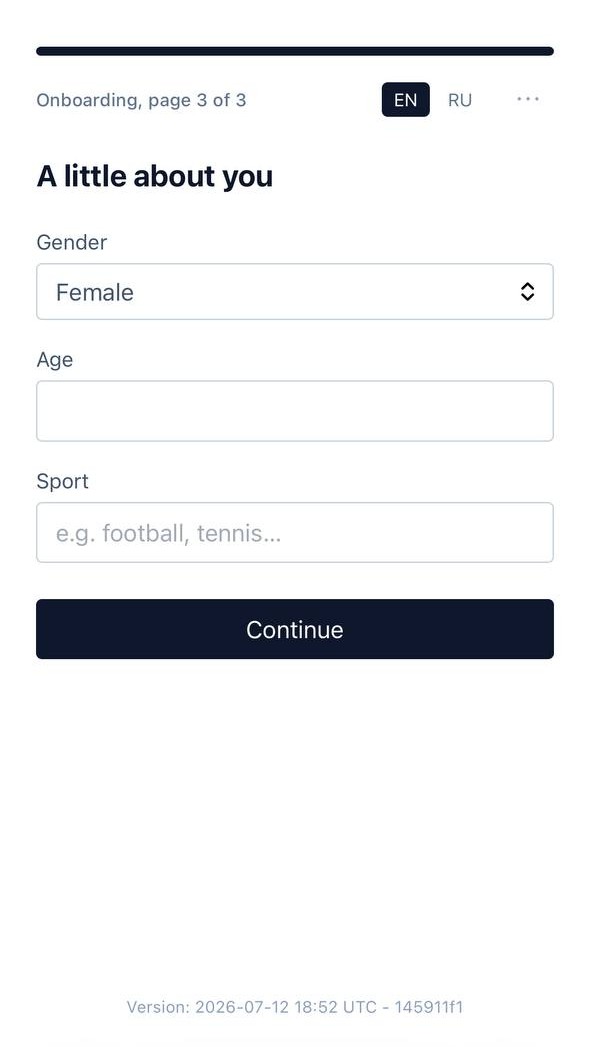
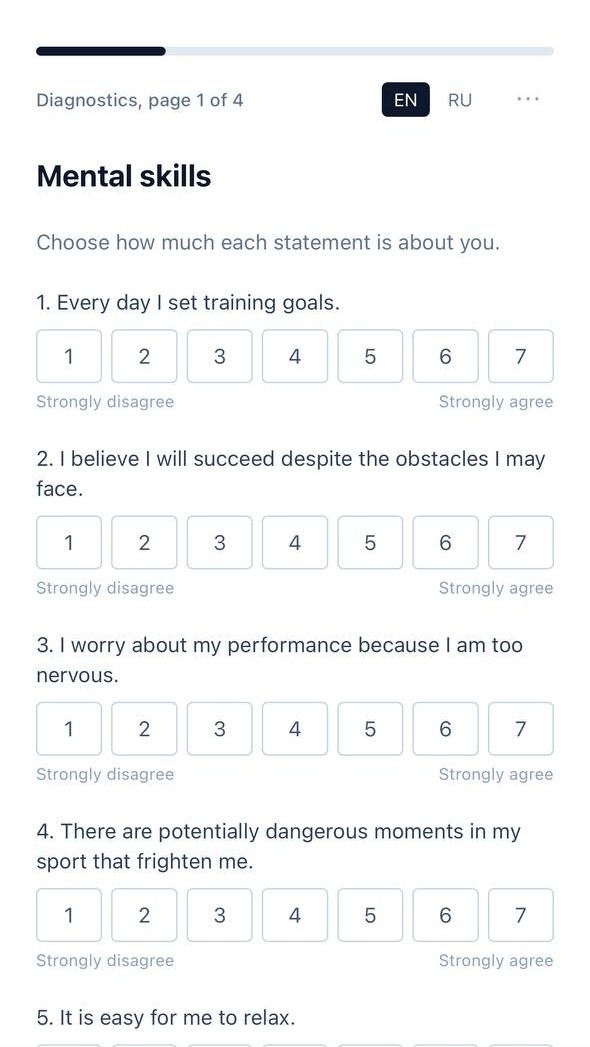
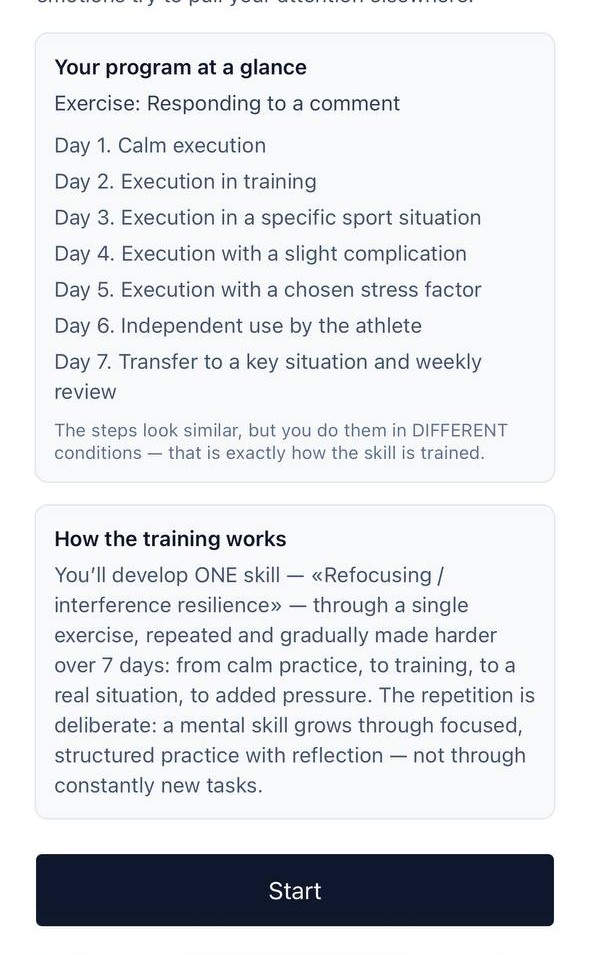
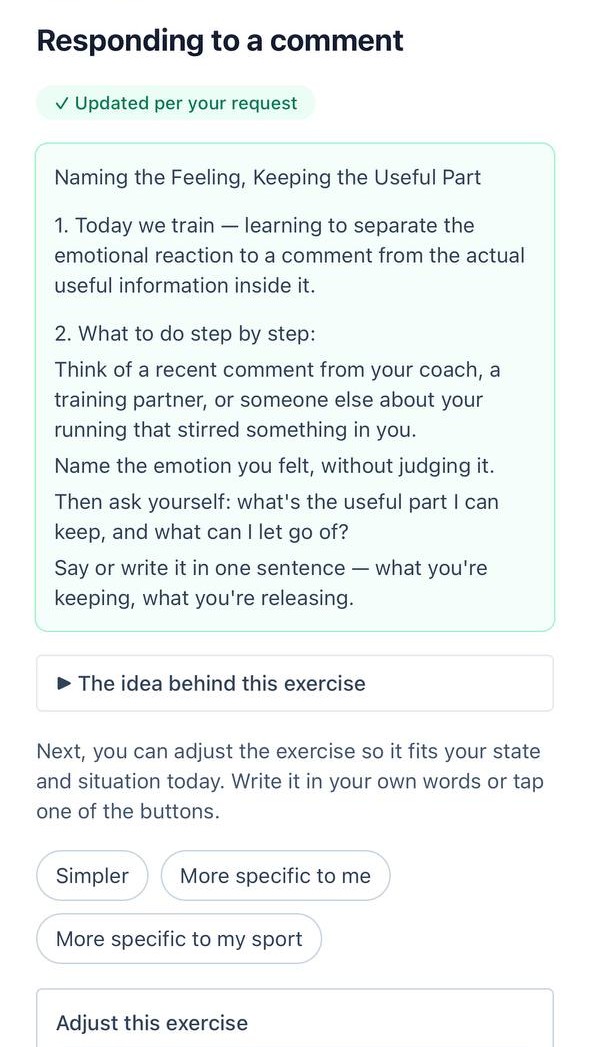
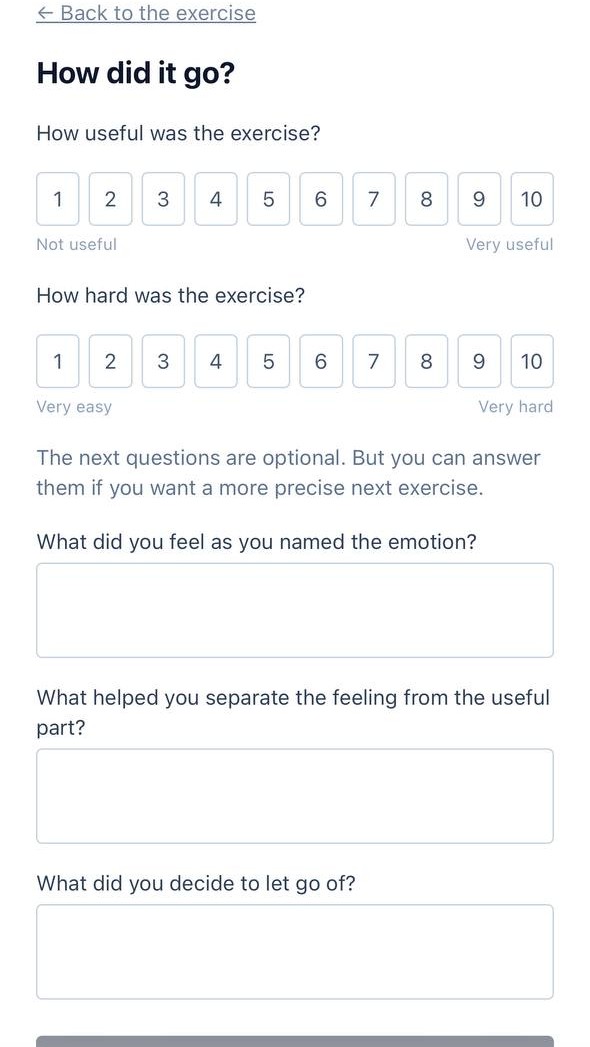
Screens from the current working prototype. The weekly programme summary is not shown here.
The short version is shown below. Open the sections for the assessment framework, progression logic, and safety boundaries.
The assessment framework draws on established sport psychology instruments, including the OMSAT and CSAI-2, alongside contextual questions about sport-specific stressors.
One priority skill and one exercise are practised for seven days through focused repetition, feedback, reflection, and increasing contextual demands.
AI supports personalisation and continuity within a bounded workflow. It does not diagnose, treat, or replace professional judgement.
The framework combines a mental-skills profile, competitive-anxiety responses, sport-specific stressors, and the athlete’s stated goal. These inputs support a transparent selection of one priority skill and one predefined exercise.
The programme draws on deliberate practice principles: focused repetition, progressive challenge, reflection, feedback, and transfer to sport situations. The current pilot does not establish the seven-day protocol as a validated deliberate practice intervention.
Forty-three adult athletes completed the full seven-day cycle and provided informed consent. This phase assessed clarity, acceptability, and perceived value rather than effectiveness.
Clarity of the core idea, perceived value of selecting one priority skill, understanding of the selection rationale, and value of sport-specific adaptation.
Mean ratings on a 1–7 scale. Preliminary descriptive indicators of user perception.
The convenience sample included 23 men and 20 women aged 18–31 from football, canoe slalom, motorsport, orienteering, rhythmic gymnastics, basketball, and running. All participants completed the full seven-day cycle and provided informed consent.
Mean ± SD ratings were: clarity 6.2 ± 0.8; value of selecting one priority skill 6.5 ± 0.6; understanding of the selection logic 5.7 ± 1.1; value of sport-specific adaptation 6.1 ± 0.9.
This initial product pilot was not reviewed by an independent research ethics committee. Formal ethics review is planned before the next controlled research stage.
The current pilot does not establish: effectiveness, reduction of competitive anxiety, performance improvement, long-term adherence, or safety in large-scale independent use.
Relationship to the congress abstract: the abstract describes the broader planned research programme. The findings presented here relate only to Phase 1 feasibility and acceptability. Planned pre–post measures of mental skills, competitive anxiety, readiness, and adherence have not yet been collected.
“The exercise I received was quite interesting. All the buttons were clear, and registration was quick. In some exercises, I asked for a simpler explanation, and that helped me understand them better.”
“Training became more engaging when I worked through the tasks.”
Anonymised participant feedback, translated from Russian.
The immediate goal is to develop stronger research designs, test the model in different sport environments, and evaluate how it can be integrated without replacing practitioner judgement.
Co-design feasibility and effectiveness studies, validate the assessment and selection protocol, and prepare joint publications.
Test the system with teams, academies, federations, or individual-sport programmes in a clearly defined practitioner-supported context.
Evaluate exercise selection, AI adaptation, reports, professional acceptability, safety boundaries, and integration between consultations.
The prototype uses passwordless email sign-in so that users can return to their programme.
Email is used for passwordless sign-in. Any project updates or research participation require separate optional consent. For generally healthy adult athletes aged 18+. Not a medical, psychotherapy, diagnostic, or crisis-support service.